


Nearsightedness rarely holds still during childhood. The eye keeps growing, the prescription keeps climbing, and new glasses correct what your child sees today without doing much about next year’s numbers. Parents looking into ways to slow that progression usually run into orthokeratology, or ortho-k for short.
Ortho-k lenses are rigid contacts your child wears overnight to gently reshape the cornea, so they can see clearly the next day without glasses, while also slowing how quickly myopia advances. Unlike the other lens options used to correct nearsightedness, ortho-k corrects vision overnight.
How Ortho-K Lenses Reshape the Cornea
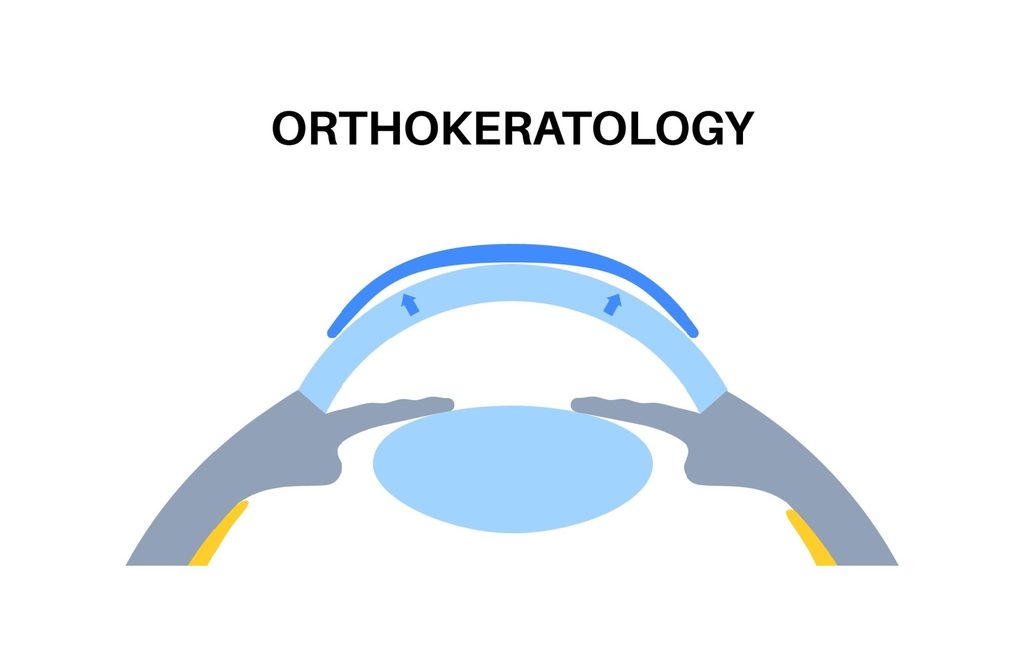
Ortho-k lenses are rigid and gas-permeable, so they hold a firm shape while still letting oxygen reach the eye. Your child puts them in at bedtime and takes them out when they wake up.
Overnight, the lenses press gently and evenly on the cornea, flattening its curve by a small, calculated amount. That changes how light enters the eye, giving your child clear daytime vision without glasses.
The effect works a little like a retainer after braces. The cornea holds its new shape while your child is awake, then the lenses go back in at night to keep it there.
Why This Matters for Myopia
Here’s where ortho-k goes beyond typical correction. Traditional single-vision lenses focus light directly on the retina for sharp central vision, but they push peripheral light behind the retina. The eye senses this and responds by growing longer to compensate, increasing refractive error over time.
Ortho-k changes where that side light lands. The flattened center keeps straight-ahead vision clear, and the steeper ring around it brings side light forward so it falls in front of the retina instead. The eye gets a different message, one that may slow how much it grows.
Either way, ortho-k aims to slow progression rather than erase your child’s current prescription. Researchers estimate that roughly 52% of the world could be myopic by 2050, and starting while your child is young may leave more room to influence where their prescription lands.
Who Can Wear Ortho-K Lenses
Children as young as 6 can often be fitted, though age is only one factor. Your child needs to handle the lenses carefully every night, either on their own or with you helping.
Hygiene matters more here than with daytime contacts. A child who isn’t ready for that routine may not get much from the treatment, and revisiting the idea in a year is a reasonable option.
Consistency matters just as much. The cornea only keeps its corrected shape with nightly wear, so ortho-k requires a habit your family can maintain through the years while the eye is still growing. The question often comes up during a child’s eye exam, when your optometrist compares this year’s measurements with last year’s.
What to Expect During the Fitting Process
Before any lens gets made, we map the surface of your child’s eye with a corneal topographer. Corneal topography is comfortable, takes a few minutes, and produces a three-dimensional map precise enough to design lenses to match the cornea’s exact curve.
Expect some trial and error after that. Your optometrist may work through 2 or 3 trial sets before finding the right fit, and full daytime correction often takes up to 2 weeks. The first few nights tend to feel strange, though most children settle in quickly.
Follow-up visits carry on from there. Each one includes some of the measurements taken before a routine exam, plus a fresh corneal map so your optometrist can see how the eye is responding.
How to Care for Ortho-K Lenses Safely
Sleeping in any contact lens raises the chance of an eye infection compared with daytime wear. Good habits keep that risk low, and they aren’t optional. Build these into your child’s nightly routine:
- Wash and dry hands before touching the lenses
- Clean the lenses with the solution your optometrist recommends, never tap water
- Use fresh solution in the case every night
- Replace the case every 3 months
General contact lens care guidelines cover the rest, and going through them with your child helps the habits stick.
Call your optometrist if your child’s eyes turn red, hurt, or become sensitive to light after a night of wear. Early attention can keep a small irritation from turning into something bigger.
What Happens If You Stop Wearing Them
Ortho-k results aren’t permanent. The cornea gradually returns to its original shape when you don’t wear the lenses consistently. Vision correction fades within days. Stopping wear abruptly, especially in younger children still growing, may also allow myopia to progress more quickly. This is a long-term commitment, not a short-term fix.
Talk with your optometrist before pausing wear for any reason, including illness or travel.
What Ortho-K Lenses Cost
Initial fitting usually costs between $1,000 and $4,000, depending on prescription complexity and how many follow-up visits the fee covers. After that, plan for replacement lenses every 1 to 2 years, sooner if one gets scratched or lost, along with regular exams.
Vision plans treat ortho-k inconsistently, and some classify it as elective. Review your coverage and payment options before you decide, and ask whether an FSA or HSA can go toward the cost.
Find Out If Ortho-K Is Right for Your Child
A comprehensive eye exam gives your optometrist the prescription history and growth measurements needed to weigh ortho-k against other myopia management options. Bring your questions about cost and the nightly routine.
Total Vision Culver City can help you sort through whether ortho-k suits your child and your family’s schedule. Book an appointment and let’s talk it through.