

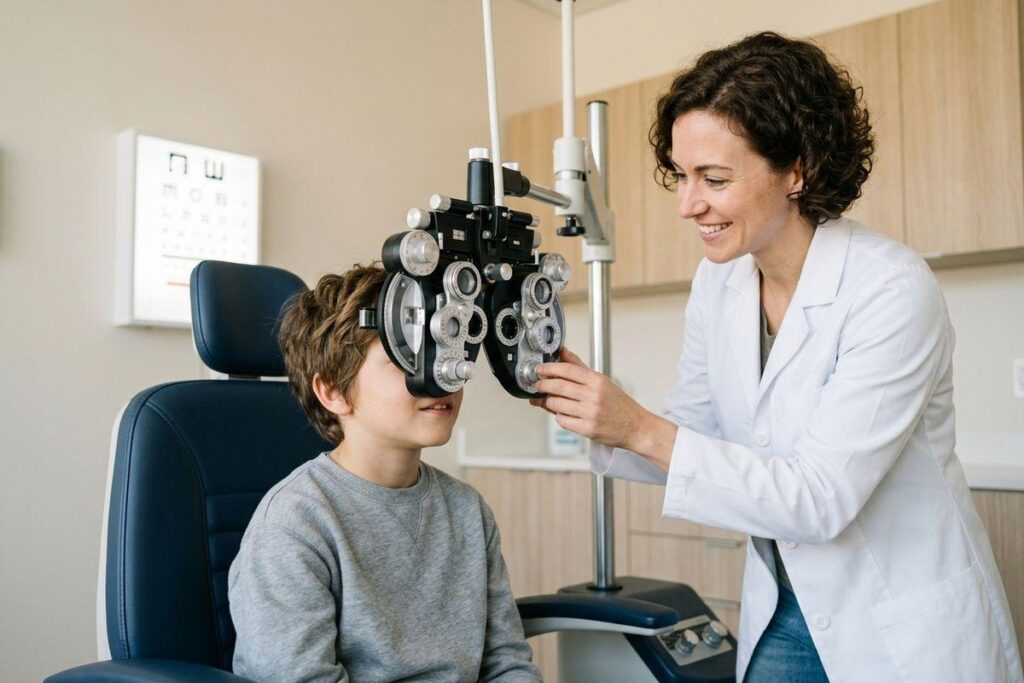
Does your child squint at the board, sit closer to the TV, or ask you to repeat what a sign says? Nearsightedness, known clinically as myopia, is one of the most common reasons kids struggle to see clearly at a distance, and it’s becoming more common every year.
Prescribing stronger glasses each year isn’t the only path forward. Myopia management is a set of treatments and habits designed to slow how fast your child’s myopia progresses, rather than just updating the prescription on repeat. That distinction matters, because myopia isn’t only a vision issue for children. It’s a long-term eye health concern that can follow your child well into adulthood.
How Myopia Progresses in Kids and Teens
Myopia develops when the eye grows longer than it should from front to back or the cornea is too curved. Light entering the eye focuses in front of the retina instead of landing directly on it, and that’s what blurs distant objects.
In kids, this growth can happen fast. A prescription that seems manageable at age 8 can look very different by age 14.
The eye typically keeps growing until the late teens or early 20s. Traditional single-vision lenses correct straight-ahead vision, but they don’t do much for peripheral vision. Light bending through those lenses can cause peripheral images to focus behind the retina, and the eye responds by growing longer to compensate. That’s often what pushes the prescription higher each year.
Risks That Come With Higher Myopia
Every diopter of myopia adds to your child’s lifetime risk of developing serious eye conditions. Cataracts, glaucoma, and retinal detachment all become more likely as myopia climbs.
Most parents don’t connect these conditions to a glasses prescription, but the link is well documented. Researchers project that myopia will affect nearly half the global population by 2050, with higher complication rates among people with severe cases. Keep your child’s myopia as low as possible during childhood, and you can lower those risks down the road.
What Myopia Management Actually Does
Myopia management doesn’t aim to get rid of your child’s glasses. It targets eye growth itself, working to slow the rate at which the prescription strengthens rather than simply correcting blurry vision as it comes.
Start early. A child who begins myopia management at age 8 has more years to benefit from slowed progression than one who starts at 14. Talk with your optometrist about whether your child is a good candidate and which approach fits their needs.

Myopia Management Treatment Options
A few different approaches fall under the myopia management umbrella, and each works a little differently.
Orthokeratology (Ortho-K) Lenses
Ortho-K lenses are rigid contact lenses your child wears overnight. While they sleep, the lenses gently reshape the cornea, and by morning, that new curve allows for clear daytime vision without glasses or contacts.
The effect is temporary and depends on consistent nightly use, but plenty of families find the daytime freedom worth it. Ortho-K falls under the broader category of specialty contact lenses, which covers several options built for unique vision needs.
Multifocal and Peripheral Defocus Contact Lenses
These lenses build different focus zones into a single lens. The center corrects distance vision, while the surrounding zones redirect peripheral light so it doesn’t signal the eye to keep growing.
They work well for kids as young as 6 and can be worn during everyday activities. Ask about contact lens exams and fittings to find the right fit for your child.
Low-Dose Atropine Eye Drops
Atropine drops have been used in eye care for decades. At very low concentrations, applied nightly, they can help slow the eye’s lengthening.
Optometrists typically pair them with glasses or contact lenses rather than using them alone, and they’ll monitor how your child responds over time. Concentrations around 0.05% can reduce myopia progression by roughly half in children ages 4 to 12, according to research on low-dose atropine.
Lifestyle Habits That Support Myopia Management
Treatment isn’t the only lever here. A few daily habits can make a real difference too.
Time Outdoors
Aim for around 2 hours of outdoor time each day. Bright light exposure appears to be the key protective factor, not physical activity alone, so it doesn’t need to be structured. A walk, backyard time, or just sitting outside after school all count.
Screen Time and Near Work
Long stretches of reading or screen use keep your child’s eyes locked into close focus. Build in breaks with the 20-20-20 rule: every 20 minutes, look at something 20 feet away for at least 20 seconds.
Keep screens and books 18 to 24 inches from your child’s face, too. That distance alone can reduce strain from prolonged near work.
Get Ahead of Your Child’s Changing Prescription
Noticed your child’s prescription creeping up year after year? Don’t wait for it to become a bigger concern.
Schedule a comprehensive eye exam with Total Vision Culver City and find a myopia management approach built around your child’s age, lifestyle, and eye health history. Reach out today and take the next step toward protecting their vision for years to come.